
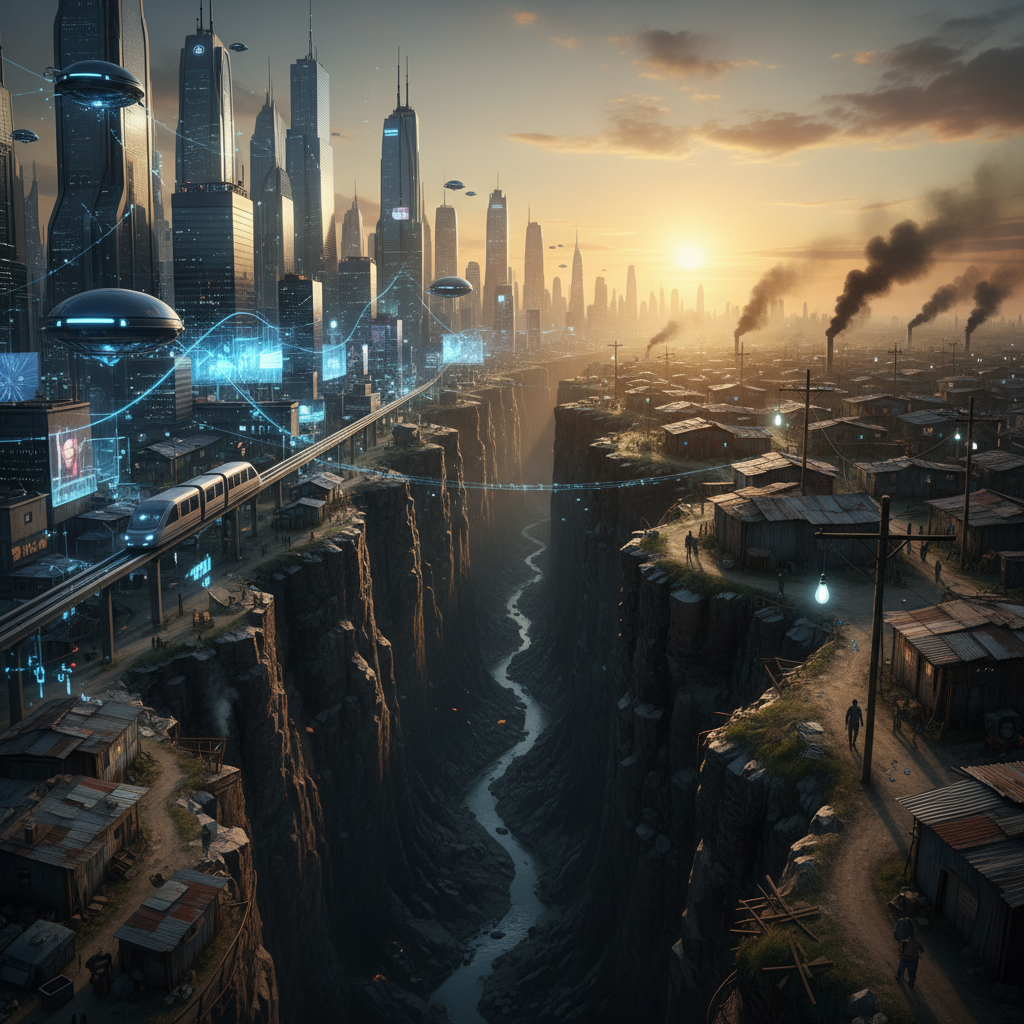
For decades, the global economic playbook followed a predictable path. Emerging nations built wealth by offering affordable, reliable human labor. Factories and call centers in Asia, Eastern Europe, and Latin America handled the tasks that richer nations outsourced. But that playbook is quickly becoming obsolete.
The New Digital Chasm
A quiet but profound shift is happening across the global economy. Economists call it the “AI productivity divergence.” Instead of leveling the playing field, artificial intelligence is rapidly widening the gap between wealthy countries and those still trying to catch up.
The math is simple. In advanced economies like the United States, Germany, and Japan, businesses are integrating generative AI into everyday workflows. Workers are using these tools to write code, draft legal briefs, and automate customer support. This has triggered a massive spike in productivity. One person can now do the work that recently required a team of three.
But in developing nations, the story is very different. The infrastructure needed to power this transition simply does not exist. Without stable electricity, high-speed fiber networks, and access to expensive advanced microchips, these nations are being left behind.
The Outsourcing Collapse
For countries like India and the Philippines, the stakes are incredibly high. These nations built massive middle classes on the back of business process outsourcing (BPO). Millions of young professionals earn their living in call centers and data entry hubs.
Now, Western corporations are realizing they no longer need to offshore these jobs. A customized AI agent can handle hundreds of customer queries simultaneously. It works 24 hours a day, never gets tired, and speaks dozens of languages. Crucially, it costs a fraction of a human salary. The traditional ladder of economic advancement is being pulled up just as millions are trying to climb it.

An Infrastructure Monopolized by the Wealthy
The International Monetary Fund (IMF) recently warned about this growing disparity. According to IMF analysis, AI is poised to affect about 60% of jobs in advanced economies. In contrast, it will impact only 40% in emerging markets and a mere 26% in low-income countries. At first glance, this might look like a shield for poorer nations. It is not. It means developing countries are largely excluded from the massive wave of productivity growth that AI brings.
Building and running AI requires unimaginable amounts of capital. Tech giants are spending hundreds of billions of dollars on specialized data centers. These facilities require vast amounts of water for cooling and a constant, uninterrupted flow of electricity. Most developing nations cannot guarantee basic municipal power, let alone support a high-tech data center hub. The computing power of the world is consolidating in a few rich hands.
The Threat of “Premature Deindustrialization”
Historically, poor nations grew rich by moving workers from agriculture to manufacturing, and then to services. AI threatens to disrupt this entire cycle. With automation making robotic manufacturing cheaper in wealthy nations, the incentive to build factories in developing regions is shrinking. This trend, known as reshoring, could trap millions of workers in low-productivity, informal jobs.
Without intervention, the global wealth gap could reach levels not seen since the Industrial Revolution. Wealthy nations will experience an era of abundance, while others face stagnation.
Bridging the AI Divide
Is there a way to prevent this divergence? Yes, but it requires a massive, coordinated global effort. Tech leaders and global policymakers are starting to call for “sovereign AI” initiatives. This means helping developing countries build their own localized, smaller AI models that do not require supercomputers to run.
International organizations must also prioritize digital infrastructure in their development loans. Funding a fiber-optic network or a reliable solar-powered grid is now just as important as building roads and bridges. Without access to the digital economy, traditional infrastructure will only lead to dead ends.
The AI revolution is not just a technological race; it is a geopolitical one. If the benefits of automation remain concentrated in a handful of wealthy zip codes, the global economy will face unprecedented instability. The goal must be to ensure that technology lifts all boats, not just the yachts.