
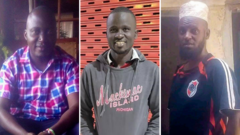
They came to say goodbye to a political titan. But for three families, a national day of mourning turned into a nightmare. Last October, thousands of Kenyans gathered at Nairobi’s Kasarani Stadium to honor the late former Prime Minister Raila Odinga. Amid the heat and confusion, gunfire erupted. Three men lay dead. Now, a deep-dive investigation by BBC Africa Eye has revealed that these three victims were completely uninvolved in the brief clashes that triggered the lethal police response.
Spectators, Not Agitators
The investigation, which reconstructed the tragic events by analyzing more than 1,500 video clips and photographs, shows that the victims stood far from the chaos. While some frustrated mourners clashed with security forces near the VIP pavilion, the three slain men were positioned anywhere from 60 to 160 meters (197 to 525 feet) away. They were spectators, not agitators.
Among them was Evans Kiche. He was a 40-year-old chef and a father of seven children. When the shooting started, Kiche was standing roughly 60 meters away from the VIP area. A single bullet to the head killed him instantly.
Further away in the opposite stands sat Jidah Burka, 42, and Vincent Ogutu, a 36-year-old father of three. They were at least 160 meters from the pavilion—entirely separated from the small group throwing plastic chairs. Yet, both were struck. Burka died from a gunshot wound to the head, while Ogutu was shot in the chest.
“The people who we look at to protect us, these are the people that cause us this pain,” said Yvonne Akinyi, Kiche’s widow, who is now left to raise their children alone. “These are the people that make us to become young widows in this country, young orphans in this country.”
How the Chaos Unfolded
The tragedy followed a chaotic build-up. Odinga, Kenya’s long-serving opposition leader, had died in India at the age of 80. His death triggered a massive wave of public grief. Fearing a security breach at the parliament building where he was originally scheduled to lie in state, officials moved the event to the 48,000-capacity Kasarani Stadium at the very last minute.
Thousands of people flooded the venue. Mourners waited for hours in 30-degree Celsius heat without water or a working public address system to guide them. Frustrations boiled over. A small section of the crowd began tossing plastic chairs toward security forces guarding the VIP section.
That is when officers opened fire with live ammunition. By tracking the movements of security personnel, BBC Africa Eye identified a group of eight heavily armed officers wearing military camouflage with their faces covered and no visible insignia. Their movements and gear match those of the elite presidential escort unit responsible for protecting President William Ruto. Forensic evidence suggests members of this highly trained team fired the shots that killed the three men.
No One Held Accountable
Kenya’s Interior Minister, Kipchumba Murkomen, defended the police’s actions, calling their response “restrained.” He claimed the crowd was throwing stones, though video evidence analyzed by journalists only shows plastic chairs and other light objects being thrown. Murkomen argued that officers were under extreme pressure after working long hours and adapting to a sudden venue change. He described the shootings as “the judgment of the police officer at the spur of the moment,” rather than an ordered assault.
A year later, no one has been held responsible. The Independent Policing Oversight Authority (IPOA), Kenya’s police watchdog, is still investigating the incident. It did not respond to requests for comment. Meanwhile, the National Police Service acknowledged the tragedy, stating that “huge lessons” were learned from that day to improve future operations. For the families of Kiche, Ogutu, and Burka, however, those lessons have come far too late.