
Saudi Energy Minister Promises Forceful Backlash After Houthi Airport Attacks
A series of devastating missile and drone attacks on Saudi Arabian airports and infrastructure has pushed the region to a dangerous new flashpoint. In response, Saudi Arabia’s Energy Minister, Prince Abdul Aziz bin Salman, has warned of a severe retaliation against the Yemen-based Houthi movement.
“The events of recent weeks are serious,” the prince told attendees at the WPC Energy Congress in Riyadh on Monday. “Our response must be equally serious.”
His speech carried a grim weight. The international energy conference was being held at a convention center just six miles from Riyadh’s main airport, which has been struck four times in the span of a single week. Despite the immediate danger, the minister insisted the kingdom remains resilient. He thanked the delegates for showing up, promising that Saudi Arabia would protect them. Still, he did not downplay the threat. He admitted that global energy security can no longer be taken for granted, adding that the recent strikes had heavily tested the country’s infrastructure, institutions, and people.
“We, as Saudis, are fearless, combatant and determined people,” Prince Abdul Aziz said. “We shall prove it to the world that whatever we are going through we will overcome it.”
A Week of Bloodshed at Saudi Terminals
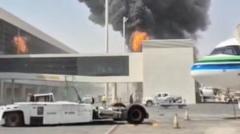
The escalation has taken a heavy human toll, with civilians bearing the brunt of the violence. The worst of the attacks occurred on Saturday, when a Houthi missile struck Terminal 3 at Riyadh’s King Khalid International Airport, killing 13 people and forcing the facility to close. The victims represented a broad international community, including:
- Four Saudi citizens
- Two foreign workers from Bangladesh
- One American
- One Egyptian
- One Jordanian
- One Syrian
- One Palestinian
- One Sudanese
- One Indian
The violence did not stop there. On Sunday, a projectile hit Terminal 4 at the same airport, killing a Pakistani resident. Just days earlier on Thursday, three Saudis, including a pilot for the national carrier Saudia, lost their lives in a pair of strikes that hit an airport facility and a parked aircraft.

The offensive quickly expanded. On Sunday evening, King Fahd International Airport in the northeastern city of Dammam came under fire. Fortunately, authorities reported no casualties from that strike. Meanwhile, the Saudi-led military coalition reported that its air defenses successfully intercepted a drone over the Eastern Province, as well as a Houthi missile aimed at the southwestern city of Khamis Mushait.
The Rebel Justification and Regional Fallout
The Iran-aligned Houthi rebels have been open about their operations. Following the weekend strikes, Houthi military spokesman Yahya Sarea released a video statement confirming the group had launched a barrage of missiles and drones toward the airports in Riyadh and Dammam, alongside two key oil and gas facilities. Sarea framed the attacks as direct retaliation for 124 Saudi coalition airstrikes launched against Yemen in the preceding 24 hours.
The humanitarian toll inside Yemen also continues to rise. The Houthi-run health ministry reported that a Sunday Saudi airstrike on a home in the capital city of Sanaa killed a child and injured six others. Sarea issued a blunt warning to international airlines and passengers, advising them to steer clear of Saudi airspace entirely, with the exception of flights traveling to the holy cities of Mecca and Medina. He vowed that rebel forces would press on with deep-penetration strikes under a policy of “a blockade for a blockade” and “an escalation for an escalation.”
An Unraveling Truce and Global Reactions
This surge in violence marks a collapse of the informal four-year truce that had brought relative calm to the region. That fragile peace shattered in July when the Houthis declared a maritime embargo on Saudi Arabia, initiating drone and missile strikes against shipping and land targets. The civil war itself has plagued Yemen since 2014, when the Houthis seized control of Sanaa. The conflict ballooned into a regional proxy battle in 2015 after Saudi Arabia led a coalition to reinstate the ousted government.
The international community has reacted with alarm to the airport strikes. United Nations Secretary-General António Guterres expressed deep shock, reminding all parties that targeting civilians and critical public infrastructure constitutes a violation of international law. In Washington, President Donald Trump stated he would make a decision on whether the U.S. military would join Saudi Arabia in active strikes against Houthi forces. The Pentagon is already supplying the Saudi coalition with intelligence and targeting support.
Meanwhile, Iran has rejected allegations that it arms and trains the Houthi rebels. Tehran expressed deep concern over the escalating violence, urging both sides to abandon military actions in favor of dialogue and diplomatic engagement.