

The streets of India’s capital are heavily barricaded. After a chaotic weekend of mass arrests, thousands of opposition supporters marched toward the Supreme Court in Delhi on Monday. They want Gyanesh Kumar, the Chief Election Commissioner, to resign. The protesters accuse him of manipulating voter lists to favor Prime Minister Narendra Modi’s ruling party. Both the government and the election commission say these charges are baseless.
A Tense March Through the Capital
By mid-afternoon on Monday, Barakhamba Road was packed. Supporters waved flags and chanted as a bus carrying opposition leaders arrived just before 3:30 PM local time. Seated inside was Congress MP Rahul Gandhi, alongside Neha Bora, a leftist student leader who has become a prominent voice in the demonstrations. A few kilometers down the road at Mandi House, Gandhi and several other leaders climbed onto the roof of the bus to wave to the sea of supporters lining the streets. Many in the crowd climbed on top of parked vehicles, beating drums and shouting anti-government slogans.
The marchers had hoped to deliver a memorandum directly to Chief Justice Surya Kant. However, Kant declined the meeting, citing “certain reasons” in a letter to the leaders. He later told reporters that some of the issues the opposition wanted to discuss are currently pending before the court. Still, he emphasized that the judiciary remains open to everyone. “Every Indian citizen has the right to approach the court,” Kant said. Gandhi confirmed that the opposition would file a formal petition now that the march is over.
Weekend Crackdowns and Mass Arrests
Monday’s march follows days of intense clashes between demonstrators and Delhi police. Over the weekend, authorities tried to shut down a demonstration organized by the Cockroach Janata Party (CJP), an unregistered pressure group. The CJP previously made headlines this summer when its protests led to the resignation of India’s federal education minister. This time, they called for a massive sit-in at Jantar Mantar, Delhi’s famous protest site.
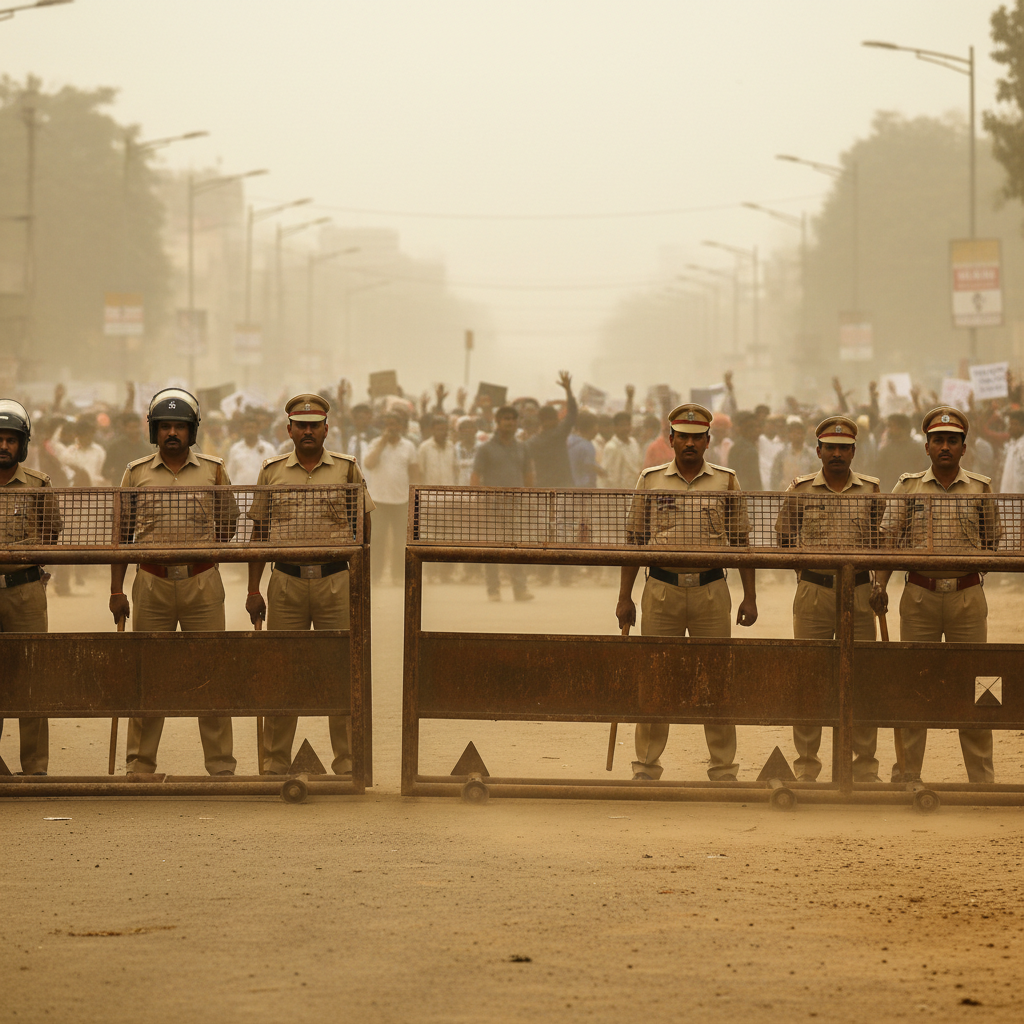
To prevent the gathering, authorities locked down the city. They canceled trains, shut down key metro stations, and deployed thousands of riot police. CJP founders Abhijeet Dipke, Saurav Das, and Ashutosh Ranka were detained directly from their plane immediately after landing in Delhi. While Dipke was later released to attend his grandmother’s funeral, Das and Ranka held a press conference vowing to continue their fight.
The police response has drawn sharp criticism. Officers swept up thousands of citizens over the weekend, including at least 16 journalists. Eyewitness videos showed officers dragging women and forcibly shoving people into buses. In one video, an officer is seen slapping a detained protester inside a bus. Reporters Without Borders issued a strong statement condemning the arrests of media personnel, pointing out that covering public events is not a crime.
Rising Political Tensions
During a press conference on Monday morning, Rahul Gandhi and Congress President Mallikarjun Kharge shared a letter they had written to the Chief Justice detailing their concerns over Kumar’s conduct. Gandhi accused the police of using excessive force against young people who came to protest peacefully. “They had love in their hearts, not hatred,” he said.
The ruling Bharatiya Janata Party (BJP) has taken a hardline stance against the demonstrations. BJP President Nitin Nabin accused the opposition and the CJP of trying to destabilize the country. He claimed, without providing evidence, that the protests are being run “at the behest of foreign forces.” Despite the government’s pushback, opposition leaders say they have no plans to back down as they take their fight to the nation’s highest court.