
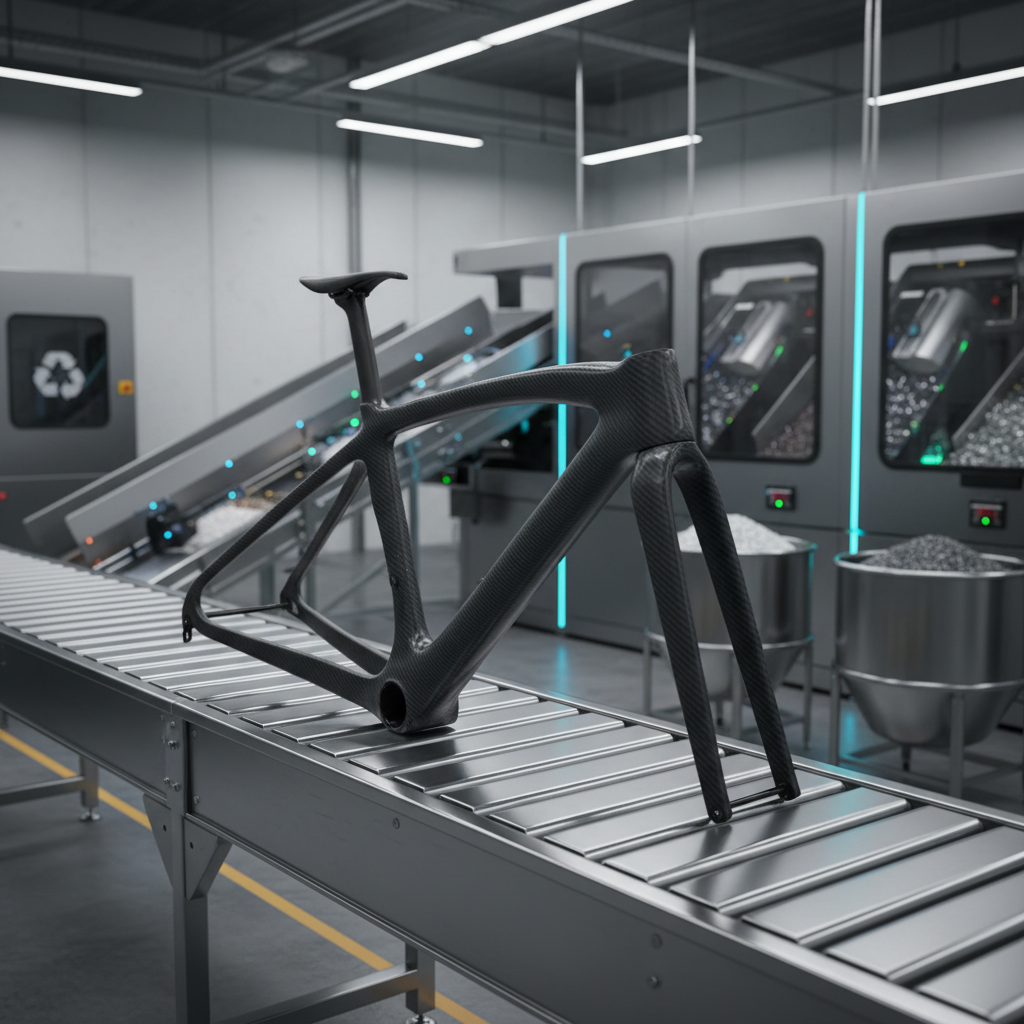
The ticking of the regulatory clock is getting louder in Brussels, and the global bicycle industry is pedaling hard to keep up. With the European Union’s strict circular economy mandates set to take effect in January 2027, major bike manufacturers are rushing to solve one of cycling’s dirtiest secrets: carbon fiber waste.
This autumn, a wave of new, fully recyclable carbon-fiber frames is making its debut. These launches represent a massive shift in how high-performance bicycles are designed, built, and ultimately destroyed.
The Carbon Conundrum
Carbon fiber is prized for its unique qualities. It is incredibly light and stiff. It makes bikes fast. However, it is also an environmental nightmare.
Traditional carbon frames rely on thermoset epoxy resins. Once these resins are cured under heat and pressure, the chemical bonds are locked permanently. You cannot melt them down. At the end of a frame’s life, it usually ends up in a landfill, or it is chopped up into short, weakened fibers for low-grade plastics.

“We have been selling a premium product with a linear lifecycle for three decades,” says industry analyst Thomas Giraud. “That model is no longer legally or socially viable in Europe. The industry had to reinvent the chemical bond itself.”
The Thermoplastic Solution
To meet the upcoming EU mandates, manufacturers are turning away from classic epoxy. Instead, they are embracing thermoplastic resins.
Unlike thermosets, thermoplastics can be melted, reshaped, and reused multiple times without degrading the underlying carbon fibers. When a thermoplastic frame reaches the end of its life, it can be dissolved in a chemical bath or heated to reclaim both the resin and the long carbon strands. The reclaimed materials can then be used to build brand-new, high-grade bike frames.
This autumn’s rollouts showcase several proprietary variations of this technology:

- Thermoplastic Composites: Using advanced polymer matrices that melt at specific temperatures, allowing easy separation of carbon threads.
- Soluble Resins: Innovative chemical binders that dissolve completely in mild, eco-friendly solvents, leaving pristine carbon sheets behind.
- Bio-Based Matrix Materials: Reducing the carbon footprint of the production phase by using plant-derived polymers instead of petroleum.
Overcoming the Performance Hurdle
In the past, engineers resisted thermoplastics because they tended to be heavier and less stiff than traditional epoxy frames. No rider wants a sluggish bike, no matter how eco-friendly it is.
However, recent breakthroughs in automated layup techniques and material science have closed the gap. The new frames debuting this season promise the same snappy acceleration and vibration damping that high-end cyclists expect. Weight penalties have been reduced to mere grams, a difference only the most elite racers will notice.
The Race Against 2027
The hurry is driven by the European Union’s looming January 2027 circular economy rules. Under these upcoming laws, manufacturers selling goods within the EU must take responsibility for the entire lifecycle of their products. This includes proving that a high percentage of their materials can be successfully recycled back into the supply chain.
Non-compliance could mean heavy fines or even bans on selling non-recyclable composite goods. Because the development cycle for a new bicycle frame takes anywhere from two to four years, brands had to act now. This autumn’s product launches are the direct result of emergency R&D budgets approved years ago.
Building the Recycling Network
Creating a recyclable frame is only half the battle. The industry also needs a way to collect old bikes. Several major manufacturers are currently partnering with European waste management firms to establish retail take-back programs.
Under these experimental schemes, riders will be able to bring cracked or outdated carbon frames to local bike shops in exchange for a discount on a new model. The shops will then ship the old frames to centralized processing hubs. It is a complex logistical challenge, but with the 2027 deadline fast approaching, the cycling world has no choice but to build this loop from scratch.