

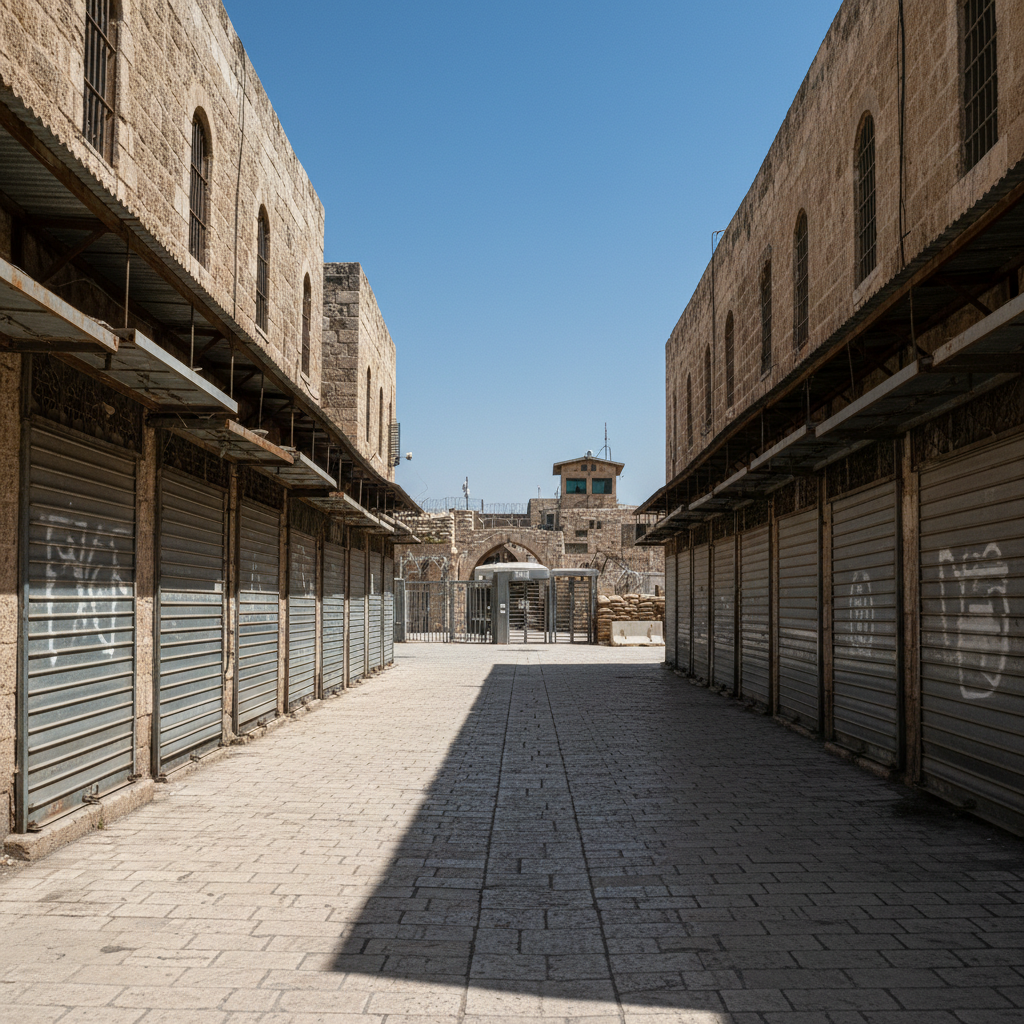
Badr al-Tamimi is 60 years old, and simple daily tasks have become an exhausting test of patience. He lives near the famous Ibrahimi Mosque in Hebron’s historic Old City. Just getting to his shop across town means navigating a chaotic maze of heavy iron gates, concrete walls, and armed soldiers.
Lately, that maze got even tighter. Israeli forces recently installed three new iron gates along a tiny 200-meter stretch of the Old City. It is a tiny patch of land, barely 200 square meters. But for the people living here, those gates represent a massive wall between them and their lives.
“They are turning this place into a ghost town,” al-Tamimi says. He is not alone in his frustration.
The New Barriers Choking the City
Hebron Mayor Yousef al-Jabari explained how these new barriers choke local life. One gate sits on al-Zahid Road. That is a major problem because it is the only road left that vehicles can use to reach the entrance of the Old City. The second gate blocks al-Shalala Street, stopping people from reaching the markets near Bab al-Zawiya in the center of town. A third gate stands further down the same street, cutting off the main pathway for shoppers on foot.
Hebron has always faced tight control, but the situation in the H2 district—the part of the city under direct Israeli military rule—has reached a breaking point. According to United Nations data, Hebron holds about 40 percent of all military checkpoints in the West Bank. Out of more than 900 movement barriers across the entire West Bank, over 10 percent are crammed into this single city.
Curfews and Closed Zones
Life here became much harder after October 2023. Before, movement was difficult; now, it is nearly impossible. Only residents with specific registration numbers on their ID cards can enter the restricted zone. For those who can get in, the checkpoints are generally only open from 7 in the morning until 8 at night. If you are late, you are locked out.
Around 7,000 to 10,000 Palestinians live in these locked-down neighborhoods, sharing the space with heavily guarded Israeli settler enclaves.
“The movement restrictions are effectively holding residents as hostages,” says Issa Amro, who leads the local activist group Youth Against Settlements. Since late 2023, the number of checkpoints in Hebron has jumped to 32, with over 130 other physical barriers blocking streets and alleys.
A Divided History
Hebron was not always like this. Older residents remember a time when the markets were packed and the streets were noisy with traffic and commerce. But the turning point came in 1994. That year, an American-born Israeli settler opened fire inside the Ibrahimi Mosque, killing 29 Palestinian worshippers.
After the massacre, instead of easing tensions, the military began dividing the city. Shuhada Street, once Hebron’s busiest commercial road, was shut down. In 1997, the Hebron Protocol formally split the city into H1, run by the Palestinian Authority, and H2, under Israeli military grip.
“They committed the crime, yet they continue to punish us for it,” al-Tamimi says.
Economic Ruin and Resilience
Today, the local economy is practically dead. Shops are boarded up, and business owners cannot get goods delivered. When Jewish holidays occur or military raids happen, the entire area goes into lockdown. Commuting times depend entirely on the mood of the soldiers on duty. Worshippers heading to the Ibrahimi Mosque are often made to wait for hours in the heat or rain.
Yet, despite the quiet streets and the constant pressure to leave, some refuse to pack up. For shopkeepers like al-Tamimi, staying open is not about making money anymore. It is about holding on to what is left of his home.
“Our presence in the Old City is a matter of steadfastness,” he says. “It is not about whether we can make a living here anymore.”