
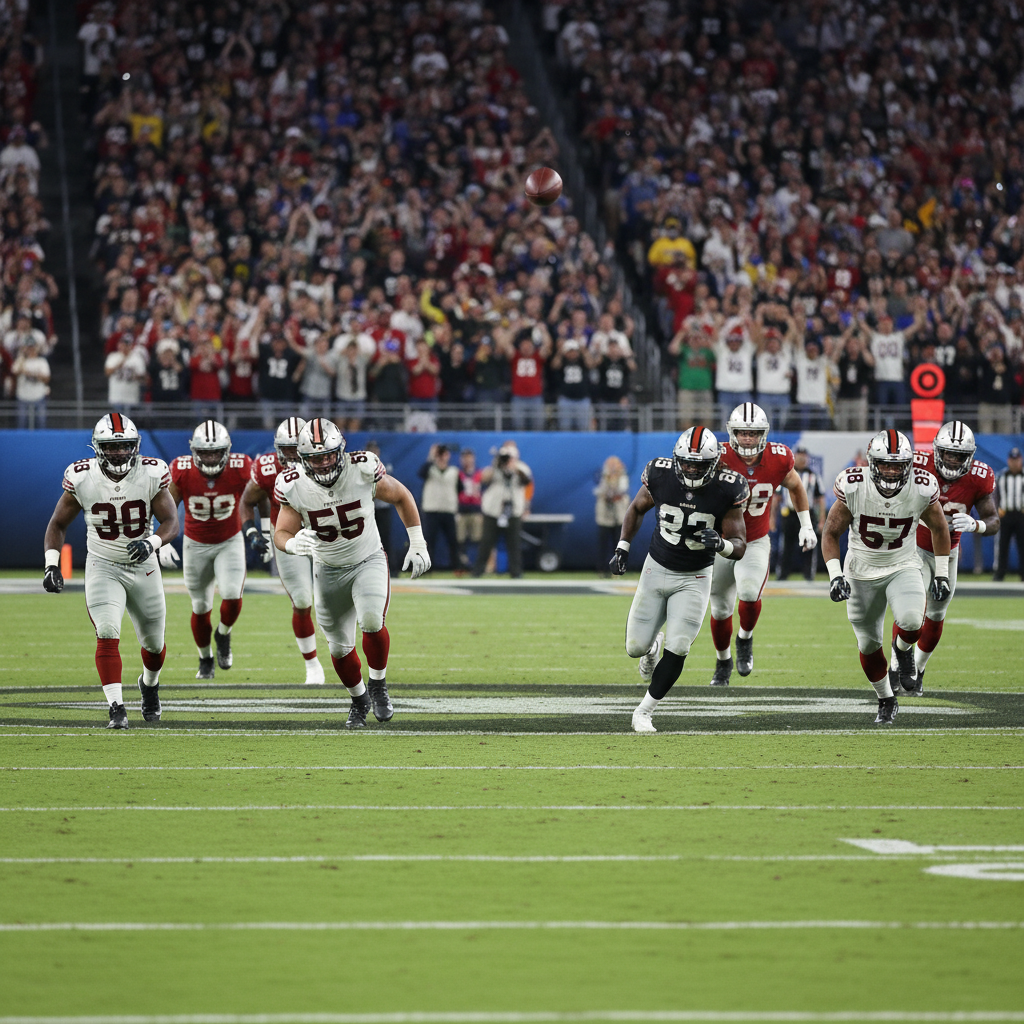
Six weeks into the 2026 NFL season, the league’s grand experiment with the “dynamic kickoff” is no longer a novelty. It is a defining feature of the game. Designed to revive the excitement of the return while drastically reducing high-speed collisions, the rule change has now yielded enough data for a clear mid-season assessment. The verdict so far is a mix of relief for league executives and a tactical headache for special teams coordinators.
According to data released by the league office, the injury rate on kickoff plays has plummeted. At the same time, starting field positions have crept forward, leading to a subtle but noticeable bump in overall offensive scoring.
“We wanted to take the high-velocity footrace out of the play,” says Jeff Miller, the NFL’s executive vice president overseeing player health and safety. “Six weeks in, the medical data suggests we did exactly that. We are seeing a much safer play without losing the thrill of the return.”
A Safer Collision Zone
Under the old rules, players on the coverage unit would sprint 40 yards downfield, building up terrifying momentum before crashing into blockers. The new setup forces both units to line up just five yards apart, starting their block and pursuit only after the ball is caught or hits the ground in the landing zone.
That minor alignment shift has changed everything for team doctors. Concussions on kickoff plays are down by 38% compared to the historical average from the three seasons prior to the rule change. Lower extremity injuries, like high ankle sprains and torn knee ligaments, have also seen a 22% decline through the first six weeks of 2026.
Instead of full-speed, open-field collisions, the play now resembles a run-blocking scheme. It is more about leverage, hand placement, and quick lateral movement than raw, blind-side power.
Return Rates Skyrocket
For years, the kickoff was becoming an empty formality. Kickers simply boomed the ball through the back of the end zone for an automatic touchback. In 2023, the return rate fell to a dismal 22%, prompting fears that the play would be eliminated entirely.
Today, the numbers tell a completely different story. Through Week 6 of the 2026 season, teams are returning 73.4% of all kickoffs. Because kickers are penalized heavily for hitting the ball into the end zone—giving the receiving team the ball at the 30-yard line—they are forced to keep the ball in play, landing it in the designated zone between the goal line and the 20-yard line.
Kickers Under Pressure
This shift has placed an unexpected burden on kickers, who can no longer rely on simple leg strength. Now, they must be placement specialists, curving and slicing the ball to pin returners near the sideline.
- Kickers are experimenting with knuckleballs and low, driving line drives to make clean catches difficult.
- Hangtime is less important than precise placement in the back corners of the landing zone.
- Mishits are costly, instantly handing opponents premium field position at the 30-yard line.
“It is a stressful play for us now,” says veteran kicker Harrison Butker. “Before, you just kicked it as hard as you could. Now, you have to hit a specific spot on the field with different spins, knowing that a bad kick instantly puts your defense in a tough spot.”
The Ripple Effect on Scoring
The rise in returns has had a direct impact on how often teams find the end zone. The average starting field position across the league has moved up to the 29.1-yard line, a significant jump from the 24.2-yard line seen a few years ago. Shorter fields mean shorter drives, and offenses are capitalizing on the advantage.
Overall scoring has ticked up to an average of 23.2 points per team per game, compared to 21.5 points back in 2023. Special teams are no longer just about field position; they are directly setting up high-scoring shootouts.
“It is like a mini-offensive play now,” says Chicago Bears special teams coordinator Richard Hightower. “You can’t just put your backup linebackers out there to run and hit. You need guys who can read blocks in a telephone booth. It has changed who we keep on the active roster on Sundays.”
Some traditionalists complain that the play looks strange, almost like a Canadian Football League alignment. But for a league obsessed with television ratings and high-scoring games, the new format is delivering exactly what was promised: more action, more points, and fewer cart-offs. How these rules play out in the biting cold of December remains the next big test.